Andrea DeCapua, "Grammar for Teachers: A Guide to American English for Native and Non-Native Speakers"
Springer; 1 edition (January 25, 2008) | ISBN: 0387763317 | 444 pages | PDF | 2,2 Mb 
The purpose of Grammar for Teachers is to encourage readers to develop a solid understanding of the use and function of grammatical structures in American English. It approaches grammar from a descriptive rather than a prescriptive approach; however, throughout Grammar for Teachers differences between formal and informal language, and spoken and written English are discussed. Grammar for Teachers avoids jargon or excessive use of technical terminology and reviews essential grammar structures clearly and concisely.
The text encourages users to tap into their own, often subconscious, knowledge of the grammar of English and to make it a conscious knowledge they can apply to their own varied teaching settings. Grammar for Teachers emphasizes looking at grammar from the perspective of learners of English, an approach that allows teachers to better appreciate the language difficulties learners of English face in ESL or mainstream classrooms. Discussions of areas of difficulties for learners of English are included throughout the text.
Grammar for Teachers makes the study of grammar interesting and relevant by presenting grammar in context and by using authentic material from a wide variety of sources, including magazines, newspapers, children's books, bestsellers, works of literature, and academic prose.
In each chapter, the numerous Discovery Activities engage users in exploring the different elements of grammar and in considering how these elements work together to form meaningful units. The subsequent discussion of each Discovery Activity allows users to explore specific elements of grammar on their own.
At the end of each chapter, additional Practice Activities ask users to apply the grammar concepts presented in each chapter. Included in the Practice Activities are samples of relevant learner errors and error analysis exercises.
http://depositfiles.com/files/3095051
paltalk

Sunday, March 8, 2009
Grammar for Teachers: A Guide to American English for Native and Non-Native Speakers

Saturday, February 7, 2009
Opportunities Pre-Intermediate Mini-Dictionary

The Language of Meetings
Lernmaterialien 2003 3125240506 8MB@RS 122 pages PDF
Publisher: Klett
ISBN: 3125240506
Average Customer Review: N/A
Format: PDF
Size: 8MB
Supplier: Amazon
Summary:
THE LANGUAGE OF MEETINGS is a lively course in the language of international meetings. It provides all the necessary language to ensure full and effective participation. Use the program that is regularly used by diplomats!
Date: 2003-07-13 Rating: 5

Essential resource for anyone teaching business students
I've found this book to be indispensible this year while teaching Business English. Deals extremely comprehensively with all aspects of the Language of Meetings. The book is divided into units such as Opinions, Agreeing,Clarifying...
The units are separated into a kind of introduction to see what language the students already know (great for the TTT approach). It then gives lists of language used for each function. Great at showing "lexical chunks" of language.
Then there's a gapfill page to consolidate and help students learn and remember.
A 'mini-task' puts the language into practice with dialogue chains, or mini-roleplays with topic suggestions. The end of the units consist of collocation matching exercises.
Great to dip into for use in more general classes, or use more methodically and work through each unit with students who reguarly have to attend meetings.
Perhaps in too much detail - I'd say it's good for use with Upper Int students and above, but with a bit of cutting and pasting, can easily be adapted for lower level learners.
BUY IT! STEAL IT! USE IT! I love it and so do my students, and colleagues, as it's never on the resource shelf but on someone's desk being used...

rapidshare.com
Opportunities Pre-Intermediate Mini-Dictionary
The Language of Meetings
Lernmaterialien 2003 | 3125240506 | 8MB@RS |122 pages | PDF
Publisher: Klett
ISBN: 3125240506
Average Customer Review: N/A
Format: PDF
Size: 8MB
Supplier: Amazon
Summary:
THE LANGUAGE OF MEETINGS is a lively course in the language of international meetings. It provides all the necessary language to ensure full and effective participation. Use the program that is regularly used by diplomats!
Date: 2003-07-13 Rating: 5
Essential resource for anyone teaching business students
I've found this book to be indispensible this year while teaching Business English. Deals extremely comprehensively with all aspects of the Language of Meetings. The book is divided into units such as Opinions, Agreeing,Clarifying...
The units are separated into a kind of introduction to see what language the students already know (great for the TTT approach). It then gives lists of language used for each function. Great at showing "lexical chunks" of language.
Then there's a gapfill page to consolidate and help students learn and remember.
A 'mini-task' puts the language into practice with dialogue chains, or mini-roleplays with topic suggestions. The end of the units consist of collocation matching exercises.
Great to dip into for use in more general classes, or use more methodically and work through each unit with students who reguarly have to attend meetings.
Perhaps in too much detail - I'd say it's good for use with Upper Int students and above, but with a bit of cutting and pasting, can easily be adapted for lower level learners.
BUY IT! STEAL IT! USE IT! I love it and so do my students, and colleagues, as it's never on the resource shelf but on someone's desk being used...
rapidshare.com
Grammar Rules!: For Students, Parents, & Teachers
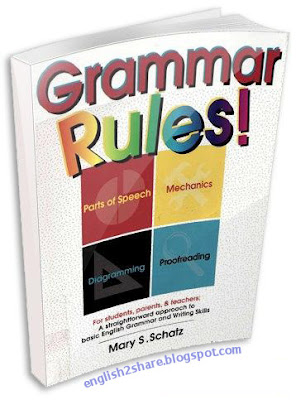
A Straightforward Approach to Basic English Grammar and Writing Skills

Here
IELTS Masterclass Student book + 2 CDs + Teacher's Book

Publisher:Oxford University Press | 191 pages | PDF+mp3 | 200 MB
Download here:
OR
Easy-share:
Easyshare - Book
Easyshare - Teacher's Book
Easyshare - CD 1
Easyshare - CD 2
Approaches to Learning (e-book)

Anne Jordan, Orison Carlile, Annetta Stack
Open University Press | 2008-07-01 | 296 pages | PDF | 4,5 MB
Professor Sally Brown, Pro-Vice-Chancellor, Leeds Metropolitan University, UK
This comprehensive guide for education students and practitioners provides an overview of the major theories of learning. It considers their implications for policy and practice and sets out practical guidelines for best pedagogical practice.
The book can be read as a series of stand-alone chapters or as an integrated overview of theoretical perspectives drawn from the philosophy, psychology, sociology and pedagogy that guide educational principles and practice. Each chapter contains:
* An accessible introduction to each theory
* A summary of key principles
* Critical insights drawn from the theories discussed
* Examples and illustrations from contemporary research and practice
* Summary boxes that highlight critical and key points made
* Practical implications for education professionals
Approaches to Learning is an invaluable resource for students and practitioners who wish to reflect on their educational constructs and explore and engage in the modern discourse of education.
Friday, February 6, 2009
New Headway: Beginner - Teacher's Book


http://rapidshare.com/files/20801623/NHWbeginTB.rar
______
NEW HEADWAY PRE-INTERMEDIATE - TEACHER'S BOOK


New Headway is the course teachers and learners can rely on.Why? An authoritative integrated syllabus, motivating topics, and clearly focused tasks combine with a real understanding of what works in the classroom. It all makes for effective teaching and effective learning. Tried and tested all over the world, it's probably the most popular course ever written! In the THIRD edition Teacher's Book, full support for the teacher: Crystal-clear lesson plans, Integrated answer keys and tapescripts, Thorough and informative coverage of grammar points, Hints and ideas for preparation and remedial, New photocopiable materials, Stop and check reviews, and Progress tests.PLUS : Class CDs/cassettes, Workbook (with or without key), Student'sWorkbook CD/cassette, Free-standing pronunciation course with CD/cassette, DVD/Video, with student's activity book, Headway online: interactive exercises available at www. oup. com/elt/headway, Online ideas and materials for teachers at www. oup. com/elt/teacher/headway, Fully revised Teacher's Resource Book, with photocopiable activities for every unit.

RS.com / PDF / 12,1MB
_________
Thursday, February 5, 2009
Introducing English Pronunciation: A Teacher's Guide to Tree or Three? and Ship or Sheep?


Introducing English Pronunciation: A Teacher's Guide to Tree or Three? and Ship or Sheep?"
Cambridge University Press 1982-08-31 ISBN: 0521285801 160 pages PDF 4,8 MB
Introducing English Pronunciation provides teachers with all the information and guidance they need to use Tree or Three? and Ship or Sheep? enjoyably and successfully in the classroom. Detailed notes are provided for each unit of both books, incorporating suggested teaching procedures and ideas for additional practice. One chapter lists the errors likely to be made by students of different mother tongues and, for students not included in this list, a diagnostic pronunciation test is included.

How to Teach English

The How to... series is a new collection of straightforward, user-friendly teacher development books designed for use by a broad range of teachers and trainers. These titles offer practical introductory information within a clear theoretical framework. This straightforward, highly readable handbook is an essential introduction to the theory and practice of teaching English. It examines a variety of teaching methods based on the author's extensive experience in the classroom and with teachers in training. The book offers ideas on lesson planning and textbook use that can be put into practice immediately.-- Explains and gives examples of current teaching methods including the Engage-Study-Activate model-- Contains a basic introductory grammar guide-- Offers practicaThis is an introduction to the teaching of English. Its emphasis is on practical issues and it is appropriate for self-study and for use with classes of trainee teachers. A variety of teaching methods are examined.

http://uploading.com/files/54G6AV0O/79306
OR
http://rapidshare.com/
OR
http://uploadbox.com/files/11f4061b4d
OR
http://rapidshare.com/files/62939960/How.to.Teach.English.rar
OR
http://w15.easy-share.com/7828281.html
OR
http://www.megaupload.com/?d=5U6RRHEB
__________
Saturday, January 31, 2009
Teaching Large Classes 4
Activities to use in Large Classes
Small group discussions: Use topics related to a theme, or ask students to submit topic suggestions.
Who Am I?: Tape the name of a famous person to the back of each student. Students go around the room asking questions and trying to identify themselves. Once they guess who they are they can place their nametag on the front and continue helping other students identify themselves.
Team spelling contests: Each student who gets the spelling correct gets a point for their team.
Balderdash: Large class can be split into teams. Teacher calls out a word and students have to write down the part of speech and definition. Each student to get both correct gets a point for her team.
Write the question: Large class can be split into teams. The teacher calls out an answer and the students have to write the question. (ex. "Lynn") Each student to write the correct question gets a point. (ex. answer: What's your middle name?")
Questionnaires: Students circulate around the room asking each other questions. Students can create their own questions on a given topic or theme, or you can provide the questionnaire handout. Follow up by asking each student to report the most interesting answer they received.
Categories: The teacher calls out a category, such as fruit, and each student has to name a fruit when it is his turn. If a student hesitates for more than five seconds, he or she has to choose a new category and sit out the rest of the game. The last person to get out wins.
Hope this would help you.
Niha
Teaching Large Classes 3
Strategies for Coping with Large Classes
Use a teacher's notebook: Attach a small notebook and pen to your belt loop. Take notes while you are monitoring pair or group learning. Review common errors as a whole group after an activity is complete.
Spread out: Find another space that your class can use for energetic whole group activities. Find a lobby or spare classroom in the building that your students can spread out into when they are preparing a project or performance. Take students outside if there is no indoor space available.
Create a participation grade: Make homework and attendance count by doing regular checks and making it part of their final grade. Giving a daily exam tip also encourages attendance.
Encourage competition: Establish a fun and competitive atmosphere within the class, by dividing the class into teams. You may change the teams once in a while or leave them the same throughout a semester. Teams can win points for certain accomplishments (If noise and behaviour is a problem, students can lose points too.).
Relax: Find ways to relax before class so that you don't feel anxious. Never attempt to prepare a lesson in the morning, right before class. Always have a water bottle handy. Always have an extra activity on hand in case something doesn't go as you expect it to.
Establish trust: Learn unique ways to remember names and do your best to get to know something about each of your students. Create a seating chart on the first day and ask students to stick with it for a while. Tell your students at least one or two things about yourself beyond your role of teaching.
Manage the noise: Establish a signal that you want your class to stop what they are doing and listen. This should be done from the first day, so that students become accustomed to it right away. Be careful not to use gestures or sounds that would offend anyone.
Reduce marking and preparation time: Design quizzes and tests in a way so that you can reduce the amount of marking. Use peer evaluations when possible. If students submit journals, just read them and leave a short comment and/or suggestion, rather than fixing every grammar mistake. Designate a specific time when the teacher's room is slow to do most of your photocopying for the week. This will save you from feeling guilty for taking up the photocopier for a long time when another teacher only has a few copies to make.
Enforce a late policy: Notify students of your late policy on the first day and stick to it. For example, don't let students enter your classroom after a warm-up has ended. If students miss class, make it their responsibility to catch up, not yours.
Share your e-mail address: In a large class, you will find yourself feeling drained before and after class if you let students come early or stay late to ask questions every day. This alone can make you hate your job, especially if you are not paid for hours when you are not teaching. Encourage students to e-mail you with questions, and answer them on your own time. If you don't like the e-mail suggestion, try finishing your class ten minutes early once in a while and allow your students free conversation time. Take questions on a first come basis during this time.
Teaching Large Classes 2
Challenges of Teaching Large Classes
Intimacy: Remembering student's names can take a while. Teachers may feel that they do not get to know their students as well as they would like to.
Anxiety: Some teachers feel anxious being so outnumbered by the students. In addition, some students are afraid to ask questions or participate in a large class.
Student needs: Meeting individual needs can be difficult or impossible when class size is very large.
Marking: Grading assignments and tests can be very time consuming, and your pay will generally be the same for a smaller class.
Distractions: There are more distractions for teachers in large classes, such as latecomers and people chatting while you are teaching.
Preparation: Making photocopies for a large class can be very time consuming. Other teachers may be bothered by how much time you spend using the photocopier.
Noise level: Large classes can become out of hand when students are working in pairs or groups. At times you may feel more like a disciplinarian than a teacher.
Monitoring students: Teachers may find it difficult to keep students on task as they monitor pair and group work.
Space: There is limited space in a classroom for energetic activities such as role-playing.
Textbooks and resources: There may not be enough textbooks or computers available for all students.
Teaching Large Classes 1
Most teachers agree that teaching a small group of students is easier, more enjoyable, and less time consuming than teaching a large group. Unfortunately, due to budgets, space, or lack of teachers, many ESL schools only offer large classes. In some schools, large classes may consist of up to 50 or more students. While your class may look more like a University lecture hall, your job is not to lecture. Just like teaching a small class, you must come up with engaging activities that keep all of your students interested and participating with the goal of improving their communication skills. While there are numerous challenges when it comes to teaching large classes, there are many coping skills and activities that you can use to make your job easier.
Advantages of Teaching Large Classes
High Energy: Classes with many students may be noisy, but they are also fun and exciting.
Timing: Classes go by quickly in a large class, and you will rarely catch yourself looking at the clock. You will regularly find yourself with extra activities that you did not complete that you can save and use in your next class.
Participation: There is always someone who is willing to answer questions even if they are just guessing. Make sure to take answers from a variety of students.
Fillers: Teachers have less need for fillers since core activities and lessons take longer to complete.
Teaching Small Classes 3
Strategies for Coping with Small Classes
Fillers: Always have plenty of fillers (such as puzzles and games) ready in case activities finish quickly. Keep a list of games or warm ups on hand to use when energy gets low. Some may need to be adapted slightly if the class is very small.
Review often: Take the time to make sure that your students understand the lessons and material.
Encourage confidence: Help shy students to feel more comfortable by trying not to put them on the spot. Let them get comfortable with you and their classmates before you start calling on them to speak up more. Remember to praise them often and save criticism for private interviews.
Change the dynamics: Invite students from other classes in once in a while. Prearrange pair group and getting to know you activities with other teachers who have small classes. If you have high level students pair them with lower level students and give them the opportunity to teach.
Ask for feedback: Take time to find out whether or not students are happy with the class. Ask for suggestions regarding activities they want to do or skills they would like to improve. Put a question box or envelope out so that students can remain anonymous if they want to.
Teaching Small Classes 2
Challenges of Teaching Small Classes
Timing: Activities finish quickly, so teachers may need to prepare more lessons and games.
Distractions: Pairs can get distracted easily since they can hear what each other are saying.
Attendance: If a few students do miss a class, planned lessons can occasionally flop. For example, you may plan a lesson that requires pair work, and then find that only three of your six students come to class.
Fillers: Teachers must always have plenty of fillers on hand for times when lessons or activities get completed quickly.
Boredom: Students may become bored working with the same pairs or groupings all of the time. There may also be less energy in the room in a small class.
Anxiety: While you will likely feel more comfortable teaching in a small class, shy students who are used to blending into a large class may be uncomfortable participating. You will have to take special measures to help them gain confidence.
Activities not always suitable: Some activities in textbooks, such as debates or role-playing, may not be possible if a class is very small. You will have to spend some preparation time adapting textbook activities.
Teaching Small Classes 1
Most teachers would agree that teaching a small class comes with many benefits. Teachers can offer one-on-one assistance at times and are more likely to meet the individual needs of their students. Some teachers, however, find it quite challenging to keep their students interested and excited about learning in a small class. Depending on the location you are teaching in, small classes range from about three to seven students. In countries where large classes are the norm, classes of twenty may still be considered small. There are numerous coping strategies and activities that teachers can use to deal with the challenges of timing and student engagement.
Advantages of Teaching Small Classes
Comfort: Teachers and students often feel more comfortable when the class size is smaller. Students generally feel more comfortable voicing their questions and opinions.
Students' needs met: Teachers can design customized lessons to meet the needs and interests of all of the class members.
Student centred: Teaching is student centred and often more communicative than is possible in large classes. Students also have more opportunity to speak.
Space: Students have plenty of space to move around in the classroom. Teachers can also arrange excursions (or suggest spontaneous ones) outside of the classroom where students can be exposed to real world English.
Attendance: Class attendance is usually high because students know they will be missed if they are absent. They also feel like they belong to the group.
Tasks Completed: Assignments and homework are more likely to be completed because the teacher is more likely to check.
Preparation time: Less preparation time is required for photocopying. There are generally enough textbooks to go around so photocopying is limited to extra activities.
Detailed Feedback: Teachers have time to provide detailed feedback when marking assignments and tests, so students get a better sense of how they are improving and where they need to work harder. Teachers also have more time to answer questions before, during, and after class


 All Comments

